


Artificial intelligence – especially in the form of large language models such as ChatGPT or Gemini – consumes immense amounts of resources during its life cycle, from hardware production to model training and inference (during use) to continuous maintenance and further development (more on this here). Energy in the form of electricity and water for dissipating heat that the servers produce during computing power are required during all phases of the life cycle.
The geographical location of the data centers that form the physical infrastructure of AI has a significant influence on the level of electricity and water consumption, but also on the CO₂ emissions linked to energy.
High consumption of electricity and water
How much water and electricity an AI model actually consumes over the course of its life cycle is not yet documented with sufficiently valid data – the manufacturing processes and supply chains are global and highly complex, there is also a lack of transparency on the part of tech companies, and there are still no reporting requirements in large parts of the world (in the EU, the first reporting requirements such as the CSRD and the Energy Efficiency Directive are only just beginning to take effect) – but some recent investigations and studies have produced initial figures.
The US Electric Power Research Institute (EPRI) found that a single query to ChatGPT has an electricity consumption of 0.0029 kilowatt hours. This is roughly ten times the energy requirement of a conventional Google search, which is around 0.0003 kWh. If you extrapolate this to the number of 1 billion requests that are made to ChatGPT every day according to Bestbrokers, this results in an electricity consumption of 2.9 million kWh per day and over a year – assuming the same number of users and requests – over 1 billion kWh or 1 terawatt hour. This is, of course, only the electricity consumption for the inference phase; as mentioned, there is currently insufficient data for all other phases.
The second resource that is consumed in large quantities is water. Here, too, initial figures are now available. A study by the Washington Post and the University of California in Riverside calculated that Meta’s Llama-3 model consumed 22 million liters of water during training alone. The study also found that a 100-word email generated by ChatGPT uses half a liter of water to cool the infrastructure. The study assumes that 10% of working-age Americans generate such an email once a week, which leads to a water consumption of 435 million liters in a week. According to the study, this corresponds to the water consumption of all households in the state of Rhode Island in a year and a half.
In addition to the extraction of raw materials and the production of components as well as all other upstream processes such as storage and transport, electricity and water are consumed primarily during the computing processes that take place in the huge hyperscale data centers. The computing processes that run on the servers are so complex and energy-intensive that heat is generated that must be dissipated. This is usually done by cooling with water. In addition, CO₂ emissions are generated wherever electricity is consumed – provided it does not come from renewable energy sources.
A decisive factor for the environmental impact of AI is the location of the data centers, as it influences the efficiency of the cooling systems, the availability of renewable energy and other ecological aspects. At the same time, economic, political and security considerations play a role in companies’ choice of location.
The influence of climate on energy and water consumption
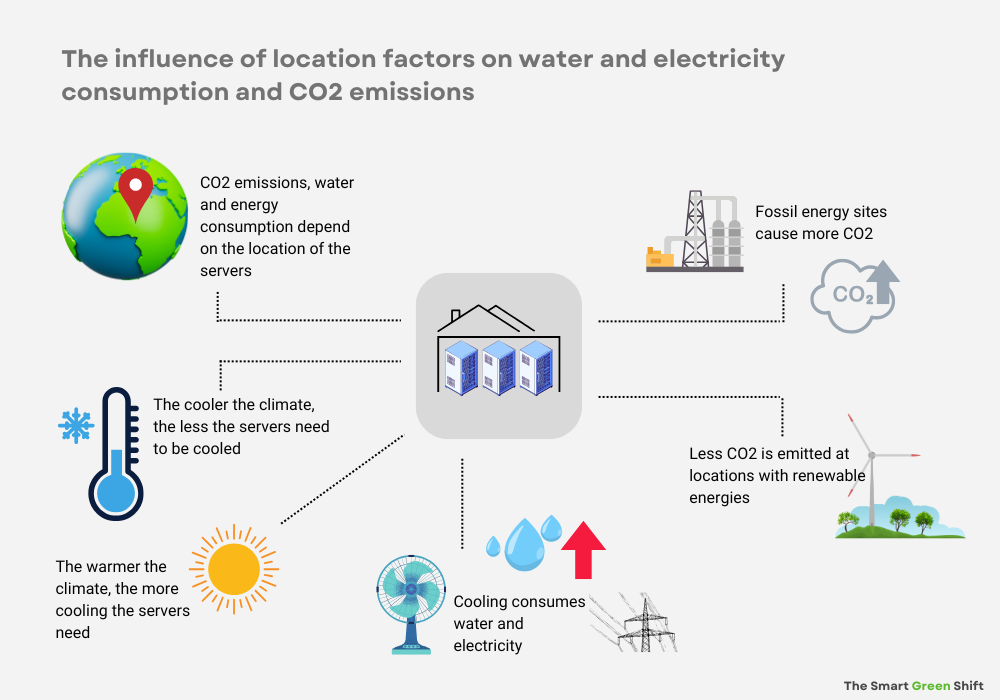
One of the most important environmental aspects when choosing a location for data centers is the climate. The operation of high-performance servers generates enormous heat, which is why an effective cooling strategy is required. In regions with a cool climate, data centers can rely on natural cooling mechanisms, which significantly reduces the need for energy-intensive air conditioning systems.
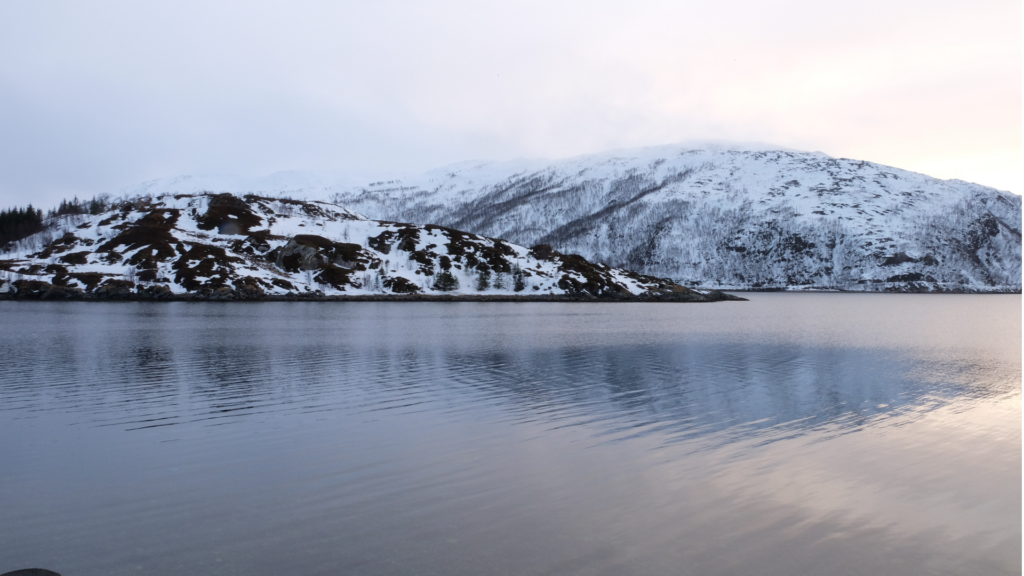
Countries such as Sweden, Finland and Iceland offer ideal conditions for passive cooling. For example, the Meta data center in Luleå (Sweden) or Google’s large data center in Hamina (Finland) use the cold ambient air for natural cooling, which significantly reduces energy and water consumption – and thus costs.
In contrast, data centers in warm climates have to use large amounts of energy and water for cooling. One example is the planned data center of Grok (XAI) and Aramco Digital (Saudi Aramco) in Riyadh (Saudi Arabia). This will require energy-intensive cooling due to the high average temperatures of around 27 °C and thus have significant energy and water requirements.
In addition to temperature, humidity also plays a role. In dry regions, evaporative cooling is less efficient, so alternative, more energy-intensive methods must be used.
Availability of renewable energy as an influence on CO₂ emissions
The type of energy source is another decisive factor in the ecological footprint of AI. Regions that have a high proportion of renewable energy such as hydropower, wind or solar energy are particularly attractive for sustainable data centers. Norway, Iceland and Canada are examples of countries where data centers can be operated almost exclusively with renewable energy. For example, Iceland benefits from its extensive geothermal resources, which enable almost CO₂-free energy production.
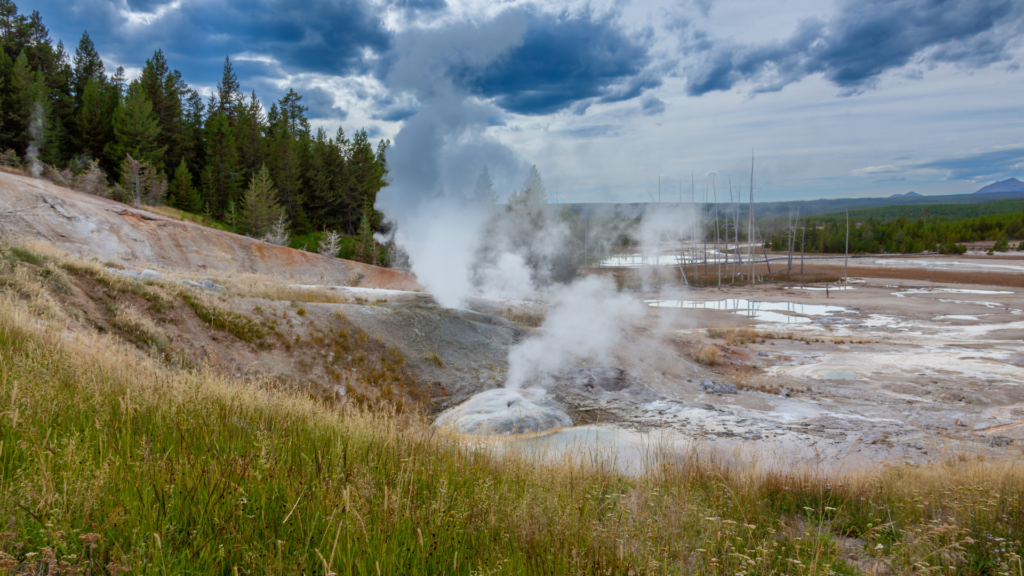
In contrast, regions that rely primarily on fossil fuels are less sustainable. In China, India and the USA there are numerous data centers that are powered by electricity from coal or gas power plants and therefore have a high carbon footprint. For example, DeepSeek’s data centers are located in the provinces of Guangdong, Zhejiang and Jiangsu, regions with an estimated 70% share of fossil fuels, especially coal.
Strategic location factors: Which aspects are crucial for companies?
But what role does sustainability actually play in the strategic choice of location for data centers? And what other criteria and aspects are crucial for tech companies?
In principle, economic and security policy aspects as well as environmental hazards play a crucial role in the choice of location. Physical security is a key criterion: data centers are critical infrastructures that must be protected against natural disasters such as earthquakes, floods or hurricanes. Companies also avoid regions with unstable political conditions in order to minimize the risk of expropriation, sabotage, cyber attacks or sudden legal restrictions.
Another aspect is the existing infrastructure: a high-performance internet connection and reliable power supply are essential for the operation of high-performance data centers. Currently, around 15% of the world’s data centers are located in Europe. By 2030, the power requirements of these data centers will correspond to the current total consumption of Portugal, Greece and the Netherlands combined. Europe is faced with the challenge of having one of the oldest power grids in the world. In order to supply new data centers with power, large investments are therefore required.
Data protection legislation also influences the choice of location. If you look at the European Union, the General Data Protection Regulation (GDPR) places particularly high demands on the protection of user data – which is the central “raw material” at least for LLMs (language models). This can be an important factor for some companies, either to locate their data centers within the European Union or, for precisely these reasons, outside it.
In addition, economic aspects such as costs for land, energy and water naturally play an important role. This is where the aspect of sustainability comes into play, even if only as a positive side effect: the cooler the environment, the lower the air conditioning costs resulting from electricity and water consumption.
At least for tech companies in the EU, sustainability is now likely to be one of the key factors in choosing the location of their data centers, as these companies are subject to European Union legislation, which, with the Green Deal, stipulated that the EU should become climate neutral by 2050. In this context, the EU has adopted the Energy Efficiency Directive (EED III), which came into force on October 10, 2023. This obliges operators of data centers with an installed IT capacity of over 500kW to collect and publish specific data on energy consumption, use of renewable energies and other sustainability aspects. The aim is to increase energy efficiency and reduce the ecological footprint through increased transparency. The EU aims for data centers to be climate neutral by 2030. This includes, among other things, the use of renewable energies, the improvement of energy efficiency and the implementation of measures to use waste heat.
But the large US tech companies Microsoft, Google and Meta had also announced that they would become climate neutral by 2030. However, the announcement of these ambitions was several years ago, and since the beginning of 2025, a There is also a new political wind in terms of sustainability: President Trump announced his withdrawal from the Paris Climate Agreement (the agreement aims to limit global warming to less than two degrees compared to pre-industrial times). It remains to be seen whether the tech giants will stick to their sustainability announcements, but there are already some indications that they will adapt to the new political direction.

Sustainable location selection as a future strategy
As the energy consumption of AI data centers will continue to rise in the coming years – by up to 160% by 2030 according to Goldman Sachs Research – sustainable location selection is more crucial than ever, especially for new data centers. Companies have to master a balancing act between ecological sustainability, economic interests and security policy considerations.
In addition to choosing locations in cool regions such as Scandinavia or Canada, one possible future perspective is floating data centers that are operated on the sea and can be naturally cooled by the cooler water. Initial pilot projects, such as Microsoft’s Project Natick, show that such concepts could be practical. Mobile data centers that can be flexibly relocated to locations with a high proportion of renewable energy could also help reduce the ecological footprint. This option would not be an alternative for KI’s hyperscale data centers, but could be an option for smaller data centers with less computationally intensive applications.
The environmental balance of data centers can be improved not only by purchasing environmentally friendly electricity, but also by using the waste heat generated. This can help to save electricity demand and thus emissions elsewhere. Companies planning a new data center in the future could therefore choose locations that allow the waste heat to be fed into the local district heating network.
In conclusion, it should be noted that the location of a data center has a significant impact on its ecological balance. Companies that invest in sustainable infrastructure and prefer locations with a cool climate and a high proportion of renewable energy can significantly reduce their CO₂ emissions. At the same time, economic, security and infrastructure factors must be taken into account in order to make a long-term, sustainable decision. The trend is (still) moving towards climate-friendly and resilient data centers that would enable us to shape the digital future in a sustainable way.
Sources
ITPro: Why Icelandic data centres are the ‘greenest in the world’.From: https://www.itpro.com/server-storage/data-centres/369253/why-icelandic-data-centres-are-the-greenest-in-the-world Retrieved: February 12, 2025
Statista: Anteile ausgewählter Energieträger an der Stromerzeugung in China im Jahr 2023.From: https://de.statista.com/statistik/daten/studie/1495796/umfrage/struktur-der-stromerzeugung-in-china-nach-energietraeger/ Retrieved: February 12, 2025
Aramco Digital: Aramco Digital and Groq Announce Progress in Building the World’s Largest Inferencing Data Center in Saudi Arabia.From:https://aramcodigital.com/articles/aramco-digital-and-groq-announcement.html Retrieved: February 12, 2025
The Washington Post: A bottle of water per email: the hidden environmental costs of using AI chatbots.From: https://www.washingtonpost.com/technology/2024/09/18/energy-ai-use-electricity-water-data-centers/ Retrieved: February 12, 2025
Bestbrokers: AI’s Power Demand: Calculating ChatGPT’s electricity consumption for handling over 365 billion user queries every year.From: https://www.bestbrokers.com/forex-brokers/ais-power-demand-calculating-chatgpts-electricity-consumption-for-handling-over-78-billion-user-queries-every-year/ Retrieved: February 12, 2025
Microsoft: Project Natick. From: https://natick.research.microsoft.com/ Retrieved: February 12, 2025
Data Center Magazine: Sustainability is Central to Hyperscalers’ Strategies. From: https://datacentremagazine.com/articles/sustainability-is-central-to-hyperscalers-strategies Retrieved: February 12, 2025
Eur-Lex: Richtlinie zur Energieeffizienz. From: https://eur-lex.europa.eu/legal-content/DE/TXT/PDF/?uri=CELEX:32023L1791 Retrieved: February 12, 2025