

Artificial Intelligence – or AI for short – has been a widely discussed topic for a few years now. While it was long considered a subject for specialists, it has since become familiar to the vast majority of people. The current widespread hype around AI is primarily due to advancements in areas such as language models (e.g., ChatGPT), computer vision (augmented reality), and autonomous systems (like self-driving cars). In particular, the intelligent chatbot ChatGPT has sparked genuine enthusiasm and catapulted AI into public awareness. These chatbots are now regularly used by many people, for example, to compose emails or quickly gather information on a topic without much research effort, whether in personal or professional contexts. Similarly, intelligent voice assistants like Apple’s Siri or Amazon’s Alexa, which are based on AI, have found their way into millions of households.
Moreover, there is growing interest in applying AI to solve real-world problems. AI is making inroads into more and more areas at a rapid pace and is now considered one of the most promising innovations of our time. People often speak of a veritable revolution – the potential, but also the risks, seem almost immeasurable. AI is also gaining increasing importance in the field of sustainability. This article takes a closer look at how AI works and how it can be used to promote sustainable practices.

What is AI, and How Does It Work?
Simply put, Artificial Intelligence – a subfield of computer science – refers to the attempt to replicate human thinking and decision-making processes using machines. It enables computer systems to solve tasks that typically require human intelligence. These tasks include recognizing patterns and language, making decisions, solving problems, or learning from experience.
The functionality of AI technology is based on processing massive amounts of data (big data) using algorithms, which are clearly defined instructions supported by powerful computing networks like cloud computing. These algorithms learn to identify patterns in the data and, based on this, make predictions or decisions.
Machine learning, a critical area of AI, is a method that uses this data to train algorithms and solve complex problems. The systems independently learn from the data without being explicitly programmed for each task. This is further enhanced by deep learning, which uses neural networks with many layers to identify complex patterns and relationships in data, such as patterns in images or speech.
The origins of AI date back to the 1950s when scientists like Alan Turing laid the theoretical foundations. However, technical capabilities were limited at the time, and the technology remained a niche topic for decades. Only with the increasing computational power of computers in recent decades and the availability of large datasets has AI begun to realize its full potential, experiencing a true revolution. Today, AI appears in various applications: voice assistants, facial recognition in smartphones, or personalized recommendations in online stores are just a few examples.
Beyond everyday life, AI plays a vital role in medicine, such as diagnosing diseases, in industrial manufacturing, and in traffic management. In the financial sector, AI helps analyze risks, detect fraud patterns, and develop automated trading strategies. AI is also an indispensable tool in research, such as simulating chemical reactions or searching for new drugs.
The Role of AI in the Field of Sustainability

We have seen that AI is far more than just the chatbots that represent this technology for many people. Beyond a variety of applications across different industries and fields, it also holds the potential in sustainability to contribute to using resources more efficiently and reducing environmental impact.
Sustainability means using resources in a way that meets the needs of the present generation without compromising the livelihood of future generations. To achieve specific sustainability goals, it is essential to leverage innovative technologies that optimize existing processes and enable new solutions. AI plays an increasingly important role in this context, as its analytical capabilities, predictive models, and automation processes help increase the efficiency and effectiveness of systems, which, in turn, conserves resources. Below are some illustrative examples.
Smart Grids – Optimizing Energy Networks
A central application of AI in the field of sustainability, specifically in energy optimization, is so-called smart grids – intelligent power grids that optimize energy consumption and production in real time. Smart grids are based on the integration of renewable energy sources such as solar and wind power into the power grid. However, these energy sources are weather-dependent and therefore difficult to predict. AI algorithms assist by analyzing weather data and consumption patterns to better plan energy production and distribution.

The use of AI makes it possible to balance fluctuations in energy production as effectively as possible and adjust consumption to the availability of resources.
Another advantage of smart grids is the integration of electric vehicles. AI can predict when and where vehicles need to be charged to minimize the strain on the power grid while making optimal use of renewable energy sources. This demonstrates how versatile AI solutions can be in the energy sector to achieve sustainability goals.
Smart Farming – Intelligent Irrigation in Agriculture with the Help of AI
Another example of the application of AI in the field of sustainability is agriculture. Agriculture is one of the largest water consumers worldwide. However, water is a precious and finite resource, and one that is essential for survival. In light of the growing global population and the resulting increase in water scarcity, it is becoming increasingly important to make irrigation more efficient. It is therefore essential to develop new methods to reduce water consumption without compromising productivity, as human life also depends on the agricultural production of food. Since one depends on the other, there can be no “either-or.” Instead, solutions must be found to use water resources as efficiently as possible in order to conserve this resource.
AI-based irrigation systems offer promising solutions in this regard. For instance, they utilize sensor data to analyze soil moisture levels, weather forecasts, and the water needs of plants. Based on this information, they can precisely determine when and how much water is needed.
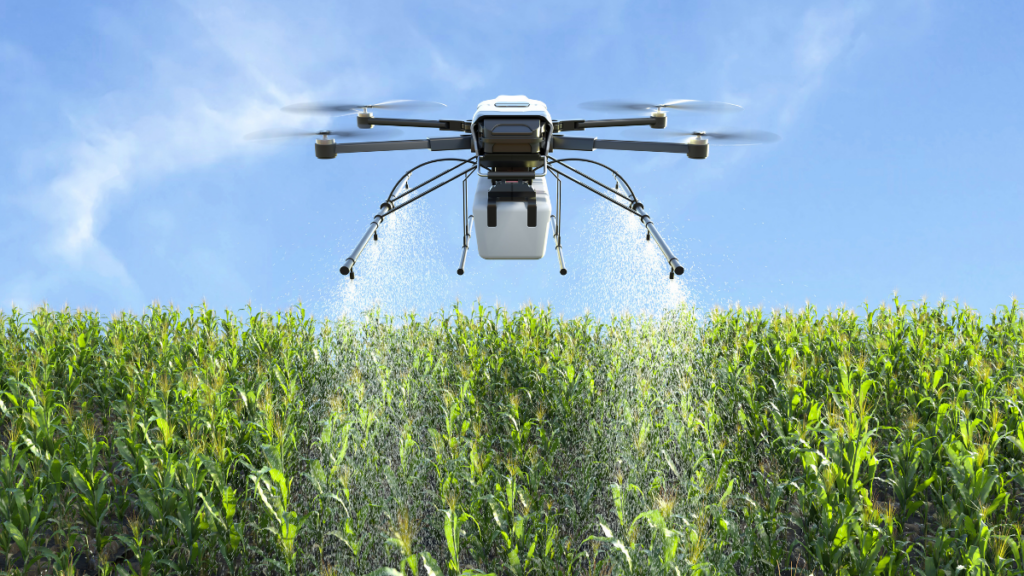
This not only leads to lower water consumption but also improves crop yields, as plants grow under optimal conditions. This is referred to as precision farming.
An example of this is the “FarmBeats” project by a well-known software company. This system uses drones, soil sensors, and weather data to determine the exact water needs of individual fields. Using machine learning algorithms, farmers can predict when and how much to irrigate. This not only saves water but also reduces energy consumption and the costs of operating irrigation systems.
Additionally, such systems help minimize the use of fertilizers and pesticides by enabling more precise control of conditions in the fields. This, in turn, protects the environment and biodiversity. The use of AI in agriculture demonstrates how technology can help establish sustainable practices while ensuring food security.
Efficiency and Transparency Through AI in Data Management

Another potential application of AI in the context of sustainability lies in the field of data management and processing. Companies and organizations face the challenge of efficiently managing massive amounts of data – from supply chains and production processes to environmental data – and deriving insights from it that contribute to improving their sustainability strategies and measures, with the overarching goal of reducing their carbon footprint (find more here).
AI helps analyze this data and derive meaningful insights from it. For example, by analyzing supply chains, inefficient processes can be identified and improved, which saves costs as well as reduces environmental impact. Similarly, companies can use AI applications in IT systems, data management, or specialized sustainability software to better track their CO₂ emissions and generate reports that meet the requirements of regulatory bodies and stakeholders.
More and more providers of IT systems and software are therefore integrating AI into their products (more on this here). Production processes can also be optimized through the analysis of real-time data from manufacturing using AI. For instance, inefficient or defective machines can be identified in this way, and appropriate measures can minimize production downtimes, which in turn saves energy and reduces material consumption and waste.
Conclusion
The potential applications of AI in the field of sustainability are diverse and indeed promising. From optimizing energy grids to intelligent irrigation systems and efficient data management, it is clear that AI can make a significant contribution to conserving resources, reducing environmental impacts, and advancing global sustainability. The examples described illustrate that AI is already a key technology today for addressing pressing ecological and economic challenges.
But, like most things, this coin has two sides. Increasingly, the challenges and risks associated with the use of AI are coming to the forefront. In relation to sustainability, one of the biggest concerns is the ecological footprint of AI itself, as its development and application consume enormous amounts of resources and leave behind a significant CO₂ footprint. Other challenges concern the ethical implications of using AI. Questions of transparency, accountability, and potential bias in AI algorithms must be addressed to ensure these technologies are used responsibly. So far, there are no real regulations in place.
Moreover, there are still many technical challenges on both public and private sides, such as the integration of AI systems into existing IT infrastructures. These processes often require significant resources and expertise.
The ongoing development and widespread use of AI certainly open up new opportunities to achieve the United Nations’ sustainability goals and secure a livable future for future generations. However, it remains a significant task to use the technology responsibly and work on solutions to ensure that it meets ecological, social, and ethical requirements.

Sources:
bitkom: Was ist ein Smart Grid und welche Rolle spielt es in der Energiewende, From: https://www.bitkom.org/Themen/Digitale-Transformation-Branchen/Smart-Grids-Energiepolitik/FAQ-1 Retrieved: January 26, 2025
Nauck, Enrico/ Spähn, Michael: Nahtlose Integration von Elektrofahrzeugen ins Smart Grid. Kommunikationsschnittstellen für das Energiemanagement, From: https://publica-rest.fraunhofer.de/server/api/core/bitstreams/91a0bae0-b2d0-4fc7-807f-1f6842e4fe7e/content Retrieved: January 26, 2025
DKE: Smart Grid: Intelligentes Stromnetz für die Energiewende, From: https://www.dke.de/de/arbeitsfelder/energy/smart-grid Retrieved: January 26, 2025
Forbes: The Future Of Farming: AI Innovations That Are Transforming Agriculture,From: https://www.forbes.com/sites/ganeskesari/2024/03/31/the-future-of-farming-ai-innovations-that-are-transforming-agriculture/ Retrieved: January 26, 2025
Massachusetts Institute of Technology: Smart irrigation technology covers “more crop per drop”,From: https://news.mit.edu/2023/gear-lab-creates-affordable-user-driven-smart-irrigation-controller-1025 Retrieved: January 26, 2025
Microsoft: FarmBeats: AI, Edge & IoT for Agriculture, From: https://www.microsoft.com/en-us/research/project/farmbeats-iot-agriculture/ Retrieved: January 26, 2025
IBM: What is machine learning, From: https://www.ibm.com/think/topics/machine-learning?utm_source=chatgpt.com Retrieved: January 26, 2025
Geeks for Geeks: Introduction to deep learning, From: https://www.geeksforgeeks.org/introduction-deep-learning/?utm_source=chatgpt.com Retrieved: January 26, 2025
Stanford Encyclopedia of Philosophy: The Turing Test, From: https://plato.stanford.edu/entries/turing-test/?utm_source=chatgpt.com Retrieved: January 26, 2025
Science and Technology: The birth of artificial intelligence (AI) research, From: https://st.llnl.gov/news/look-back/birth-artificial-intelligence-ai-research?utm_source=chatgpt.com Retrieved: January 26, 2025
Software Improvement Group: The history of AI: from Alan Turing to today’s resurgence, From: https://www.softwareimprovementgroup.com/the-history-of-ai/?utm_source=chatgpt.com Retrieved: January 26, 2025
Forbes: Artificial Intelligence’s New Role In Medicine, Finance And Other Industries,From: https://www.forbes.com/sites/qai/2023/02/02/artificial-intelligences-new-role-in-medicine-finance-and-other-industrieshow-computer-learning-is-changing-every-corner-of-the-market/?utm_source=chatgpt.com Retrieved: January 26, 2025